16 March 2014

Garmin 620 race predictor

Late last year I got a new Garmin 620 running watch.  It has cool features like measuring ground contact time, vertical oscillation and step cadence.  It also 'predicts' VO^2 max and also has a race prediction algorithm that estimates your potential in a few race distances.  Previously I've reviewed how the VO^2 max varies over time, so today I can at least start reviewing the accuracy of the race predictor.  Here's what my watch thinks I can run the following distances in: 
I'm finally starting to do some running races this spring so I can make some comparisons. I ran in a 10k in Sisters, OR last Friday, and two days later, I ran a 5k in Bend.  The 10k was on trail and although it was not extremely hilly, it was pretty technical trail run, with lots of corners and river bottom like rocks.  So my final time was 39:16. I was happy with it even though my watch didn't think I was reaching my potential.  I'll chaulk it up to the technical trail.

Then on Sunday (today) I ran a 5k mostly road run with very little hills although it wasn't dead flat.  I also think the course was about 0.1km short, at least according to my watch.  My time was 17:44!  Look that's only 1 second off from my watch prediction!  I know the course may have been a bit short, but I found it pretty funny anyway.  Also, I've never run a sub 2:50 marathon but I think I have it in me! My 1/2 marathon PR is also very close to 1:21:15; only about 1 minute slower. 

So far my only complaint with my Garmin 620 is the heart rate often spikes to maximum for the first 10-15 minutes of my runs, a common problem.  I'm pretty frustrated by it, so if anyone has any ideas let me know.  I've tried a few things, but so far nothing seems to solve the problem all the time, especially on cold / dry days. 

27 February 2014

Strava Android vs Garmin 620 (XC Skiing) comparison

So I use Strava, and I also use Garmin.  I sometimes use my phone (Motorola Moto X on verizon) to record workouts in strava.  I've been wondering, how good is the phone at tracking position / speed during a workout, vs my expensive Garmin watch?  The phones have got alot better at position, especially the iPhone 5S which can monitor motion / movements while using even less battery.  Technology has improved alot in the last 5 years with phones.

Here's my semi detailed comparison of the Garmin 620 (admittedly a running watch), and the Strava android app for tracking a cross country ski workout (technique: classic) at Mt Bachelor Nordic center near Bend, OR.  The temperature was in the mid-upper 20s and I was using a combination of some start grip tape (under foot) with a mix of Swix blue extra, and toko red in the kick zone.  The phone was in my front jacket pocket, and the watch was on my wrist (under my sleeve).

GarminMoto X
Moving time2:32:252:30:05
Distance (KM)31.5631.7
Avg moving speed (KPH)12.612.6
Max speed (KPH)50.254.0
Elevation gain (meters)613664

The basic statistics appear to be very similar.  The distance is off by about only about 1/2 percent.  The average speed matches pretty much spot on.  The moving time is also very close.  My phone measured my top speed at 54.0, almost 4 kph more than my watch.  Based on the map in Figure 1, the precision of the position on the moto x was a little noisy during downhill sections, but quickly became very good after slowing down.

Fig 1: Strava Android app recording of downhill section on blue jay loop.
The paths really come together for the workout recorded on the phone, as they should, since I was always skiing on the same trail. Now compared to the Garmin GPS (fig 2) the data from the phone is looking pretty good. The Garmin watch seems to have a steady offset, rather than adjusting after changes in speed. By looking closely at the maps, I'm impressed how close the final numbers were for both devices.
Fig 1: The Garmin 620 on same downhill section, skied many times on same workout.
I will continue to use my watch (and my phone) to track workouts.  I pretty much use my Garmin watch exclusively for tracking running workouts, since it's really built for running, and has running specific features like cadence, ground contact time and vertical oscillation.  With the hardware on more phones implementing features to accommodate fitness tracking, it seems like Garmin may have their work cut out for them.  However, I still do not like to carry my phone while running, but with the announced Samsung Galaxy S5 having ANT+ capability, hopefully more phone manufacturers will follow suit, since phones do seem to have a pretty good handle on the position tracking.

19 February 2014

Garmin 620 VO^2max

I was sort of an early adopter to the new Garmin 620 smart watch.  Well, it's smart in that it has a heart rate strap with an accelerometer in it, so it is able to measure your cadence, vertical oscillation (how high you 'bounce') and also ground contact time.  It also measures your average stride lenght for the run based on all the parameters.  So far I really like it. It's super easy to use, automatically uploads to Garmin connect and Strava (with copymysports). I honestly don't know if it's worth the price, but I don't regret buying it, yet anyway.

One of the cool things it does is measure (or estimate) your VO^2max.  Below you can see the trend since I got the watch in late November.  I hadn't been running a ton before then so you can clearly see a trend of increased fitness.


Essentially it measures your heart rate and pace, and uses a formula to calculate your estimated VO2max. You can see the formula in action on the two points I highlighted.  Point (1) I visited Mesa, Arizona and ran in Mesa (1,243ft ele) one day and the next day in high elevation Flagstaff, AZ (6,910ft ele).  It makes sense that I would have a higher pace / lower heart rate in Mesa than in Flag, especially considering my buddy and I summited Elden lookout (~9200ft) on the run in Flagstaff.  Also, on point (2), I was traveling to central California where it is around 375ft elevation. Now I'm back in Central Oregon so I'm sort of back to my current baseline of 57.

Hopefully I'll update this again later in the year, after a few more key workouts and races.

22 January 2014

Hemochromatosis maintenance

Finally got around to making some plots for the ferritin numbers over time, along with frequency of therapeutic phlebotomies.

Figure 1: Original ferritin decline with partial phelbotomies plotted. Early phlebotomies not counted.

Figure 2: Hemochromatosis maintenance since original de-iron at end of 2006. Clear increase in ferritin since 2nd quarter 2012 indicates more therapeutic phlebotomies required.

Doctor indicates safe ferritin for HH patient is ferritin less than 50 or so.

04 October 2013

Rejected blood

I'm a little outraged that the red cross won't let me donate blood into the regular blood bank.  Since I have Hemochromatosis, they will take out my blood, but they just throw it down the drain.  (well not literally).

This is not the FDA restricting the blood from HH positive people; they allow it.  This is 100% the red cross and their stupid politics.  here's a direct quote from the red cross website:

The American Red Cross, which controls about 45% of the nation's blood supply, does not currently accept donations from people with known hemochromatosis. Everyone agrees that the blood is safe and of high quality. There is no risk of passing on a genetic disease through blood transfusions. But the Red Cross has a long-standing policy that potential donors are not allowed to receive direct compensation for their donation (beyond the usual orange juice and cookie). Because people with hemochromatosis would otherwise have to pay for their therapeutic phlebotomies, they would in effect be getting something of value for being able to donate for free. Thus the Red Cross has ruled that such donations violate their policy.
BS! If I had an alternative way to give blood and have it go to a blood bank I totally would.  I estimate that I will be prescribed to give blood between 4 and 8 times a year for the rest of my life!! That's a lot of blood for people who might need it.

See if you have any alternatives to the Red Cross to give blood in your area, and also, encourage them to accept blood from hemochromatosis patients if they don't already.

09 September 2013

Pillager Mud Run Special


Ran in the Pillager Mud Run last weekend and had a lot of fun.  The mud was just a little watered down, but it was still yucky and muddy.  The local public TV station did a nice little production on it, and I gave away my training secret:  American Ninja Warrior!!!

Fun times in MN for sure.

Red Cross doesn't want my O- blood

Just got a letter in the mail stating the Red Cross will no longer use my iron rich 'hemochromatosis' O negative blood in the regular blood bank anymore because of "technology upgrades". I'm pretty disappointed by this and really wish there was an alternate blood bank here in town that I could go to. They said they would still extract my blood at no charge but it will go to waste. I'm hoping to start a revolution to get this decision turned around. I have O negative blood and it's the same as anyone elses. My extra iron isn't in my blood, it's in my body and when I give blood my body uses my extra iron to create new RBCs. In other words, my blood is the same as everybody else.

Just had to vent.

08 June 2011

Comeback 2.0

In Oregon there are three important stage races for the amateur bike racer: The Mt Hood Cycling classic, the Elkhorn Classic and the Cascade Classic, each of these races are three days long. The Oregon cyclist can live the dream and doing the stage race and spend a weekend bike racing on some very epic and scenic courses. Unlike Pro tour riders, there are no team cooks or breakfast buffets every morning, (unless you pay way extra). This summer, my comeback to road bike racing, I plan to do the three stage races in the 'cat 3' category. (Bike racing lingo: cat 5 is beginner, cat 1 is almost pro).

Last weekend, the first of the three stage races took place: the Mt hood cycling classic in Hood River. In my opinion, Hood River is the most beautiful town in Oregon, and alot of that has to do with the columbia gorge. The race consists of 4 stages over 3 days.

Stage 1
The first stage started in the Dalles, and covered territory between the Dalles and a small town called Mosier. The race was on some of the same roads that the columbia gorge marathon travels in October, a foot race that I've done twice, so I was somewhat familiar with the route. However, there was one section that I was not familiar with, and this section included what is known to the locals as '7 mile hill'. Before the race I was talking with my teammates Pete and Erik, and predicted that around 15 riders would be in the lead group, and if you were not in that group, it would really suck to be trying to chase back on. I don't like to make up excuses, but I had to take antibiotics for three days in the week prior to this race for a sinus infection, which was very taxing on my system. I'm not going into details but I didn't have 'full power' on 7 mile hill, and I don't think it helped to have the climb with a slight tail wind on one of the first 70+ degree days of the spring. It was a pressure cooker and it was hot, and my lungs were still coughing up the 'gunk'. To make a long story short, I was dropped by the lead group on the climb and had to chase to get back as much time as possible for the last 20 miles with 7 others in the same position. Interestingly, exactly 15 riders finished the stage on the lead, and Pete was one of them. I finished just over 4 minutes later.

Stage 2 (11 mile TT)
The second stage was an 11 mile time trial in Trout Lake, WA. Even amateur riders use the tricked out TT bikes, or fit their road bikes with clip on bars and disc wheels. I decided to bring less to the race, so I was on my road bike with regular bars and no disc. The result here was I lost 3 more minutes to the leader.

Criterium
I was scared of this race because of the hairpin corner after the downhill, but it was mostly safe until the last corner, where a dude crashed and the ambulance came, but he ended up not leaving in it. I ended up ahead of the crash, and was 11th.

3 Summits Road race
71 miles with huge climbs in the mountains north of Hood River on paved single lane forest roads. After losing time on Friday, I was mixed about how this could go. In chatting with guys from the team we agreed that this would not be an attack fest, and more of a war of attrition. The first two climbs were tough, but I was able to hang on. The downhills were fast, and I drove down the second big decent, because being behind other riders on the brakes during the first one was just too stressful. Hung on until the last steep uphill mile with the selection of 15 riders in the field, and moved up on GC from 40th to 16th, by far my best overall finish in an Oregon cat 3 stage race. Looking forward to Elkhorn on June 17-19, where the 1st and 2nd place riders from Mt Hood will be racing, so it will be tough!


23 November 2010

Runner overcomes obstacles

Runner overcomes obstacles

Bend’s Ryan Ness deals with health disorder while competitive running

By Amanda Miles / The Bulletin
Published: November 23. 2010 4:00AM PST
Ryan Ness, 35, runs in Drake Park on Friday with his greyhound Jazzy. Ness recently won the Columbia Gorge Marathon.
more photos more photos | order photo

Ryan Ness, 35, runs in Drake Park on Friday with his greyhound Jazzy. Ness recently won the Columbia Gorge Marathon.
Rob Kerr / The Bulletin

advertisement:

Two just might be Ryan Ness’ lucky number.

Two months ago, Ness moved to Bend for the second time after spending a few years in Portland.

And last month, he won the Columbia Gorge Marathon in his second time running the Hood River-area event (and in the race’s second year, no less).

Or maybe Ness, 35, is just plain lucky. Lucky enough that when he discovered in 2006 he had developed hemochromatosis, the diagnosis was made before the disease — a disorder of iron metabolism — appeared to have caused any lasting damage.

Running is not the only sport in which Ness participates. He also cycles and cross-country skis, and he races in multisport events. Don’t ask him to pick which of the sports he likes best, though, as it tends to vary with the seasons.

“If I had a favorite, I might try to just do that (sport) more,” Ness says. “I just like fitness and keeping in shape and endurance sports, really.”

Growing up in St. Cloud, Minn., Ness was always active. He ran cross-country in high school and also cross-country skied, but he says he did not win many races — he was a middle-of-the-pack type of kid.

But it was more about the lifestyle than the results for Ness. He took to heart the examples of some influential coaches, and of his marathon-running parents.

“I had that ingrained in my head that that’s what I kind of wanted to be like when I grew up,” he says.

So Ness kept training and got better, fitter, faster. He ran marathons, competed in Midwest nordic ski races, did triathlons.

In 2003, he even completed the Ironman Wisconsin triathlon — a 2.4-mile swim, a 112-mile bicycle ride and a 26.2-mile (marathon) run. He finished 64th out of about 1,800 participants with a time of 10 hours, 39 minutes, 5 seconds — a respectable mark for a first-time Ironman contestant.

That has been his only Ironman to date, though by his own design.

“It was fantastic,” Ness says. “I had a really good experience, so I kind of think that maybe I’ll just turn that page because if I go back and do another one, it might be horrible because you have that chance of having a horrible Ironman.”

His athletic lifestyle made Ness a natural fit for a place like Central Oregon, where he moved with his wife, Laurie, a nurse, in 2004, telecommuting for his job in computer programming.

Ness continued to compete in endurance events. He even placed in the top 10 in the elite men’s division of Bend’s multisport Pole Pedal Paddle race in both 2006 and 2007.

It was during the year between those two PPP races that Ness was diagnosed with hemochromatosis, a genetic disorder that causes the body to store too much iron, which can lead to health problems later in life such as arthritis, organ damage, or failure of the liver, heart or pancreas.

Hemochromatosis affects roughly five in every 1,000 people in the United States, according to the National Digestive Diseases Information Clearinghouse website.

The diagnosis came almost by fluke. Ness’ younger brother, Kelly, had gone to the doctor for an unrelated illness. But when his blood work showed high iron levels, Kelly was diagnosed with hemochromatosis.

Upon learning of his brother’s diagnosis, Ryan decided to undergo testing as well. And those tests revealed that he too had hemochromatosis, though he was not yet manifesting any symptoms.

No one else in Ness’ family has been diagnosed, though he suspects one of his grandfathers — who died in his early 70s after suffering from arthritis and heart disease — might also have borne the disease.

Ness’ treatment was simple. To remove the excess iron from his body, he had to have blood taken until his iron levels fell to an acceptable range.

The hard part was that he had to do so weekly for about 30 weeks in succession.

“It’s not the funnest thing to do every week,” he says. “It got really draining, not only going there again and getting poked. I think I recovered pretty quickly from them — but just week after week after week of getting this blood out of me. I was really tired.”

Not long after his weekly blood draws ended, Ness moved to Portland. He had decided to shift from computer programming to a career in engineering. He and Laurie, who is also from Minnesota, moved in June 2007 so Ryan could attend an Oregon Institute of Technology satellite campus in Portland.

Life in a bigger city proved to be an adjustment for the couple. And something was missing.

“(Portland) wasn’t all bad because it’s not cold in the winter, but we both grew up in snow, and we like to be closer to the snow, so that was hard,” Ness explains.

A job in test engineering with PV Powered gave Ness the opportunity to come back to Central Oregon. He and Laurie returned to Bend this past September.

And the very next month, on a scenic marathon route along the Columbia River, Ness pulled off one of the biggest accomplishments of his athletic career.

He knew going in that he had a shot to win. He had placed third in the marathon’s inaugural edition in 2009, and neither of the men who had beaten him had entered the 2010 race.

He started out conservatively, and about four men passed him early in the race, he recalls.

But Ness had a plan.

“I knew the course because I’d ran it the year before, so I kinda knew the race wasn’t going to be won in the first six miles, so I didn’t start out fast,” he explains.

The course for the Columbia Gorge Marathon begins in the town of Hood River and heads east toward Rowena before eventually looping back on itself and returning to the start. It is challenging and hilly. One climb is especially grueling: From the eight-mile mark to about 14.5 miles, the course climbs roughly 800 feet.

Hence, Ness’ patient start paid big dividends, as he took the lead with about six miles remaining.

Ness had never previously won a marathon because he typically ran in bigger races such as Twin Cities and Portland (where he set his personal best of 2:53:54 in 2004), marathons with massive fields and often won by professional runners.

His first win was in doubt until the very end.

Unbeknown to Ness over the latter stages of the race, another runner he had previously overtaken was hanging tough. With the marathoners blending in with participants in a half-marathon race being staged simultaneously over much of the same course, Ness did not realize until about half a mile from the finish that the runner in second place was only a few seconds behind him.

“I didn’t have a lot left,” Ness says, “so that’s why I was surprised and scared when I saw him, because I knew if he was coming fast, it would have been hard for me to react to a kick at the end. When I saw him, I just kind of went as hard as I could for the rest of the way. And he was kind of probably in the same situation as me, but I didn’t know that at the time.”

What Ness had left turned out to be just enough. He held off Win Goodbody, of Portland, for the victory in 2:57:13.4.

He won by 8.6 seconds.

“I haven’t won very many (races), so it was really cool to win it, and it gives me more confidence for the future,” he says.

Ness is not sure what his immediate future holds regarding his competition schedule, though he plans to do some cross-country ski racing this winter, make his return to the Pole Pedal Paddle next May, and likely go back to Hood River next fall to try to defend his marathon title.

Perhaps more important, he is definitely back to his old self, as fit as he was before his diagnosis. And his treatment these days is much less rigorous: He has to have blood drawn only two to five times per year.

“There’s a lot worse things that could be wrong with people,” Ness says, “so I feel kind of fortunate in that respect.”

Or to put it another way, just a little bit lucky.

Amanda Miles can be reached at 541-383-0393 or at amiles@bendbulletin.com.

10 November 2010

Drunk Monkey

My friend shot this video, it is classic.

01 June 2010

This is fascinating.

Not only do all the pro bikers dope w/ blood, they cheat with batteries too. This is actually pretty convincing. he just takes off from the rest without even looking like he's attacking.

08 April 2010

UND Fighting Sioux

The Souix are losing their name! Even though I rooted for their hockey team to lose, I liked their logo. I bet the sales for their hockey jerseys will benefit next year (the last year of the Sioux) I even want one!. And football games at NDSU won't be the same either because (at least when I went there) the home crowd often yelled 'Sioux suck shit', even when the team wasn't even playing the Sioux.

At least Ralph Engelstad had around 2,000 Sioux logos embedded into the 100+ million dollar arena the team plays in. Good luck covering up all of them! Now they can replace them with the UND prairie dogs, or UND ground hogs or something.

04 April 2010

Shamrock run and Vernonia half

A couple of weeks ago I had a pretty good race at the Shamrock 15k run in Portland, it was a pretty big race with a combined 20+ thousand people in the 5k, 8k and 15k... But it was nowhere near as memorable as the Vernonia half marathon that I ran yesterday...

In the week leading up to the Vernonia, the weather forecast was for a big storm coming into the PNW with low snow levels of around 1000 feet. I'd never been to Vernonia, but a co-worker of mine lives there and he said the elevation is around 600 feet, so all week I was mentally preparing for battle with rain. Car-pooling to the start with Jerry M, we decided it was a good idea that we left 15 minutes before our planned time, because we were actually getting into some snowy driving conditions. We drove by the finish area, which looked pretty snowy, more like a springtime scene common around central oregon, not Vernonia. We were going to a running race and not a nordic ski race right? The race is point to point, and you get bussed back to the starting area after you finish (sorta like some big midwestern ski races - vasaloppet, birkie).

We made it to the starting area with plenty of time, and although it wasn't snowing, it was damp and low to mid 30s. Not sure how many people there were, but it was alot, They said it was the biggest vernonia 1/2 ever despite the rough weather conditions. The race started and it promptly started to snow! There's a short out and back section for the first 2 miles and then we headed out to Stub Stewart State Park rails to trail trail.

The first 6 or so miles was like running on the springwater trail except there was a feeling of being a bit more back in the woods. As we progressed the snow got a little deeper and although it wasn't snowing or raining hard, it was a steady precip most of the way, with alot of drops and snow clumps falling from the trees. Right around miles 8-10 is where it got more interesting. The pavement turned into a gravel rail bed, and there was mud, snow and big (unavoidable) puddles. it was possible for a while to keep the feet from getting drenched, but after a while the straight line mentality took over and just running right through was the most efficient (and most fun) choice. I was impressed with how my new Nike Lunar Glides drained water though! The last few miles included a steep downhill, cross a road and then a steep uphill in the snow slickened loose gravel, and then a gentle descent to the state park where the finish line was, but not before one last but very unexpected climb in the last 1/2 mile up to the finish line.

The Vernonia 1/2 was definitely a battle this year. There were not very many PR's here today, but I'm sure that everyone that ran Vernonia this year had some pretty good stories. It was definitely a run I'll remember for a while and I'm sure you'd agree if you were there. I managed to run it in 1:25:24 which I was really happy with, considering the conditions. I was shooting for 1:22.5 which would have put my pace faster one of my friendly rival Sean's winning pace at yakima marathon the week prior.

On the bus ride back to Vernonia, the bus driver told us how high the water got during the major flooding the area went through this area a couple of years ago. It was astonishing (it was a really major flood), and aside from some houses that appear to have been raised up, you wouldn't know it. All of the folks helping out were very friendly and the soup at the finish was hot! THANKS VERNONIA! see you next year.


20 February 2010

lost (shoes)

This was to be my 3rd attempt at Hagg Lake to complete the 50k. The first was my best, and also the least muddy. Last year will be remembered as a disaster, and this year I decided to switch to the 25k (only one lap around the lake). The weather was fantastic and we had about 4 sunny and dry days leading up to the race, which lessened the mud situation, but there was still a good amount of mud, which there will always be at Hagg pretty much no matter what.

On the way to the race I had to get gas, and during the fill up with the engine off, i left the car lights on. Upon attempted re-starting the engine, it barely turned over, and I thought, oh crap, come on car!! so after I shut off the lights and waited a few seconds, it still turned over real slow, many times, but eventually fired and i was on my way.

After getting through Forest Grove, I missed the left turn on to scoggins road for Hagg lake, oh crap and it was no big deal, because I wasn't late. And I arrived with plenty of time to chat with the local crowd and jog a little bit. The race started, and the out and back was short, and then we hit the trail. I think I took a wrong turn in the first spot it was possible to take a wrong turn, and didn't lose much time, but it was kind of a bummer. I also realized while trying to make up time, that I have not been racing on trails much and you can't just put it in cruise and hammer out miles like you can on the road, you have to pay more attention on the trail or you'll fall down. So even though I didn't fall down, I attempted to miss a couple of significant mud puddles and pretty much completely failed, getting both shoes wet on the first half.

The second half on the run around the lake I was going OK, and had lost all hope of trying to keep the feet dry, and was monster trucking straight through the mud sections, which was great for the mentality and enthusiasm. But then I missed another turn, and didn't really go too far off course, but did add some distance. You'd think this was my first lap around Hagg lake, but it was actually my 5th (counting the last 2 years).

With about two miles to go one of the dudes in the 50k that we were passing told me I was the 10th one, so I decided to hold that position. Or try to hold that position. I could hear people behind me, but was feeling pretty good as running through the mud (instead of trying to awkwardly avoid it) was great fun. Then on what I thought was a huge mud section (that I didn't remember from years past) with about 1+ mile or so to go, I was racing through it, and it was deeper and stickier than I thought and I lost a shoe. I went a couple more strides before I could turn around and retrieve it, but this thing was buried, and another 25k-er was right there. So I left it and continued with one shoe. I got about 40 yards, and figured out that it really was awkward running with one heavy mud soaked shoe so I took the other one off too, and went minimalist style (socks only) for the last maybe 3/4 mile into the finish, holding off the dude who passed me when I lost the shoe, for an official finish of 9th.

Then, as a slight reward, I was handed the medal for the age group winner for the 30-34 age group!!! wait, I'm 35!??!?! I tried to say, "Well I'm 35" but I think they used the age that you were, when you registered, which I apparently did when I was still 34. So that was pretty cool, even though the dude that I out raced while barefoot in the final mile, who was 10th, was actually really 34 years old and probably should have got the medal, so it was a bit awkward, but the race people told me to keep the medal so I did.

Anyway, it was fantastic weather, and even though I lost the shoe deep in the mud, it was a good race. My next race is officially the shamrock run 15k (thankfully on the road, probably closed roads to boot), but I might go to silver falls next saturday for a low key trail run, and then I hope to run the April 3rd Vernonia half marathon. I will have a busy couple of weeks with important work meetings, job interviews and finishing up two classes at school, so the schedule is a bit up in the air, but the shamrock run is 100% on.

Here's the shoe that made it:


The other one will probably become fossilized and the next civilization will find it in a million years.

17 November 2009

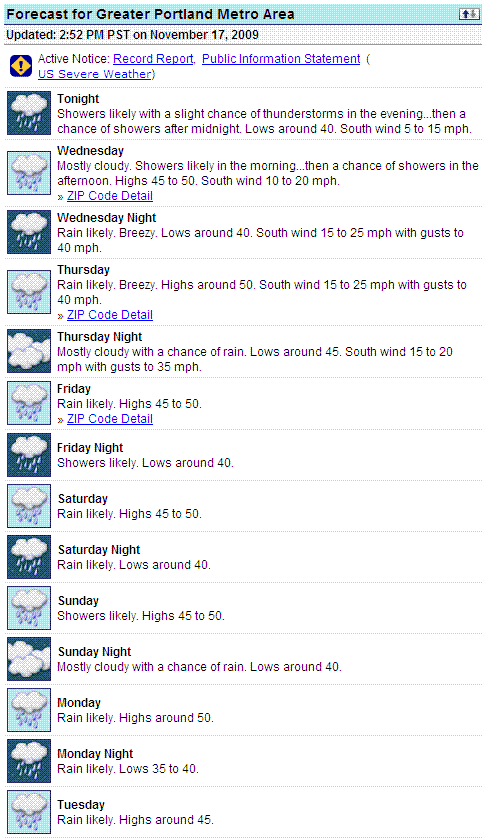
Forecast


OK it usually doesn't rain all day everyday, but not a very sun-shiny forecast. Winter in the PNW. Snow in the mountains though!

06 November 2009

Columbia Gorge Marathon saga

Since I've been meaning to write a post for over a week now to recap the columbia gorge marathon, well, here goes! This year, I really wanted to do a fall marathon. Since my MN days, running the twin cities a few times and chicago, I really wanted to get the feel of another marathon. Running in the fall is just the best. The cool air, the leaves on the trees, can't beat it. I ran Portland marathon in 2004 (our 1st year in Oregon), so that was the last road marathon for me.

I found out about the CG marathon way back last spring when we were having breakfast with our friend and neighbor Susan and her sister Leslie and her husband. Leslie lives in Hood River, and said that they were thinking about organizing it, they found a sponsor, this and that... So I told her to keep me posted. Pretty much immediately when I got word of the race being on, I registered and started thinking about how sweet it was going to be.

Well my training plan was working pretty much perfect. We got back from spain, and I started doing long runs and even some speed work, and I was in pretty good shape, even though I wasn't doing many races, but I was planning on running a 1/2 marathon in Bend 2 weeks before CG marathon. Then, two weeks and six days before the race I was doing a 'recovery' run in Forest Park, and tripped on a rock or root or something, and smacked my ribs pretty hard. I tried running on that Thursday, and was in too much pain. the next week I took it easy but biked one day (felt crappy, ribs hurt). The weekend before the marathon I was able to do some easier running, but it was still hurting. The days leading up to the race it really started to feel better, each day, which gave me confidence that I should at least be at the starting line.

I drove out there on race morning, and was a little intimidated by some of the strong winds in the gorge in the amazingly dark early morning; if it was going to be that windy, the race would not be fun. Finally I arrived at the start area and a few people were around, but it was calm and non crowded as ever. Had a good chat with Leslie, Win (fellow pdx runner) and Kelly (pdx run oregon blogger). Finally made it over to the staring line and found Sean, good buddy (and rival) from central oregon. We chatted, took some photos, and then it was getting time to start. Chad (race director) did a little speech and then he said GO! The 7 or so miles were nice, just chatting with Sean and Win like it was a wednesday noon run or something. Rather uneventful, except that we noticed some of the mile-markers didn't seem right. We got to Mosier and Sean picked up a gu and put the hammer down. I tried to keep him in sight, but was only successful in keeping the 2nd place guy in sight. However, it was at this part of the race where I knew I was going OK (ribs weren't going to stop me today).

One of the coolest moments of the race was near the 1/2 way and high point on the race profile there was a helicopter hovering really low and taking some photos. It felt like we were getting tour de france style coverage! Then it was a right turn and downhill back to Mosier, where I arrived in 2nd place, with no sign of Sean. The long climb back up to the bike bath to hood river was a real grinder, and I was taking it at my pace and went back to 3rd. I did not lose too much time however and still had intentions of trying to catch Joel for 2nd place with even 2.5 miles to go. Then I just said to myself, you are having a great race, just hold on for the finish. The last 2 miles flew by (maybe a little short), but the feeling of finishing this race in sub-2:55 fashion was pretty outstanding, especially after my lack of any workouts that felt decent in the three weeks prior.


Since the marathon, Laurie left for a 2+week trip to Vietnam for operation smile, and I've been really busy with work and school, and it started getting dark really early. What is the point of daylight savings anyway?


18 October 2009

Probable

OK, here are a couple of spain pics (bike related). we were there for almost 2 weeks and saw alot of other stuff (no bullfights), but seeing la Vuelta was pretty memorable. start


Here is a pic of big mig! We saw Miguel Indurain. My friend Sean (sorta jokingly) asked me if we saw Indurain in spain, and was surprised when I said yea!!! Other (cycling) stars we saw were Cadel Evans, Fabian Cancellara, David Millar, Tyler Farrar, Vinokourov, Valverde, and a bunch of others. Vino almost won the stage we saw the finish of (he ended up 4th), and why is it that these dopers are worshiped is beyond me sometimes. Especially when 34 year olds are still dropping dead. I'm as guilty a fan as anybody I guess. I hate Valverde, as he is sorta not just a suspected doper, but an actual doper banned in Italy!!! and he is the hero and love of all the spaniards, winning la Vuelta. I guess maybe Contador is a bigger spaniard star, but he didn't show up at la vuelta this year.

cadel
As for Cadel Evans, he is the man. I was glad he got world champion stripes, the media makes him out to be a dork, but I think in real life he's a good guy at least from my observation after stage 10. Too bad he got that flat tire at Vuelta.

millar
I thought Millar would have been uglier for some reason... He's a former doper, and now he's on the clean team Garmin, and I was going to say he never wins anymore, but he went on to win the final TT at La Vuelta, so maybe there's hope for the sport.

We're going to the race across the sky movie showing on Thursday, to see the leadville 100 mt. bike race documentary. Should be pretty cool, and I think I'm going to wear the dopers suck wrist bands for fun, and it will probably give me a little inspiration for Sunday (columbia gorge marathon), and future goals, maybe even leadville 100.

Upgraded to probable for the marathon. I'm pretty sure it will be a struggle, but I'm pretty stoked, and have been looking forward to this for a while. The crash a couple weeks ago was luckily after most of my important training, but I still feel like I haven't done enough running (and ate too many donuts) in the last 2 weeks to make a good race out of it (sub 3?). Someday I want to go sub lance (which is somewhere in the 2:50 range). One thing is for sure: running through the tunnel on the way back is going to be awesome, but it's still a ways to the finish.

13 October 2009

Day to Day

After a long lapse, I'm updating the blog. Since updating, we took a pretty sweet trip to Spain, which I hope to post a recap at some point. In short I'll just say that southern spain is a very arid landscape and the weather is hot. We saw the Vuelta

In preparing for the Columbia Gorge Marathon on Oct. 25th, I had been getting into some good form. It's been 5 years since I've ran a road marathon(ran Portland marathon in 2004 in PR time) and I'm really looking forward to this one. The course is challenging and it's got a view of the gorge most of the way. If the weather's bad it could turn out to be an epic cold and windy death march. Two weeks ago I did yasso 800s averaging 2:46 per half mile, which (according to Bart Yasso) translates to the potential of being able to run a 2hr 46min marathon. I pre-ran the final 18 miles of the CGM course felt great. I was all scheduled to run a half marathon tune up last sunday, and then last week, on a 'recovery' run at forest park, I was running on the trail and instead of staying on erickson drive, I needed to warm up so I ran up to the wildwood on wild cherry trail and came back down dogwood, where I proceeded to crash on the down hill, tripping on a root or rock or something. It wasn't running fast, but running downhill that translated into a harder fall, and I didn't catch myself really at all, and basically landed on my side and managed to scrape both the left and right shins (very minor road rash). The worst was the impact to the lower right ribs, and if you've ever had a rib injury you know the drill. Hurts to laugh, hurts to sneeze, hurts to cough. Well try running. So I tried running 3 miles last week and it was not happening. Rested the weekend and got a couple hours on the bike yesterday in a desperate attempt to keep the fitness. Feels a little better this week than last week (but it's more sore after the bike ride), so my status is day to day for the CGM.

I'm nearing completion of school and will be looking to land a job staring in 2010 (around Feb or March). What does that mean? I don't officially get done w/ school until June2010, but I only have one class for the spring term. So the job will probably be here in the valley (portland / hillsboro area). My plans are to get employment in the semiconductor industry as it relates to solar cell manufacturing. The outlook looks pretty good. The program at the school I'm in really could prepare a student for potential employment in the wind, solar (manufacturing), solar (residential), hydro, bio-fuel or electrochemistry (fuel cell) industries. At this point I'm hoping the solar manufacturing thing works out, as I already have an internship at the largest solar cell factory in the Americas. And my senior project (call it Bachelors Thesis) topic is studying the light induced degradation of mono-crystalline CZ silicon solar cells.

Hope somebody still reads the blog, and hope to write a killer race report for the gorge marathon. And if the race doesn't go so well, that's ok, but I should be on the starting line.

27 September 2009

2009 Vuelta a Espana - Stage 10 finish

It goes by pretty quick!!!

here's Simon Gerrans winning stage 10 of LA VUELTA!